
Introduction
Anyone who drives through the West Midlands already knows the truth: the m6 walsall birmingham lanes closure situation isn’t a rare inconvenience anymore—it’s a routine disruption that forces drivers to think ahead, reroute, or sit through delays that feel avoidable.
This stretch of motorway has moved past being “busy” into something far more frustrating. It’s unpredictable, frequently restricted, and increasingly shaped by ongoing works and reactive closures. Ignoring it or treating it like a one-off issue misses the bigger picture.
Why this specific stretch keeps breaking down
The section between Walsall and Birmingham carries more pressure than most drivers realise. It’s not just commuter traffic—it’s freight, long-distance travel, and regional flow all stacked onto the same corridor.
The m6 walsall birmingham lanes closure pattern keeps repeating because this part of the motorway is doing too much at once. Junctions are packed tightly, merging traffic never really settles, and any disruption—even minor—spreads quickly.
It only takes one lane to close for the entire system to slow down. When two or three lanes go, delays aren’t measured in minutes anymore.
This isn’t just about volume. It’s about design limits being tested every single day.
Roadworks aren’t temporary anymore
There’s a point where “temporary roadworks” stops feeling temporary. That point has already passed here.
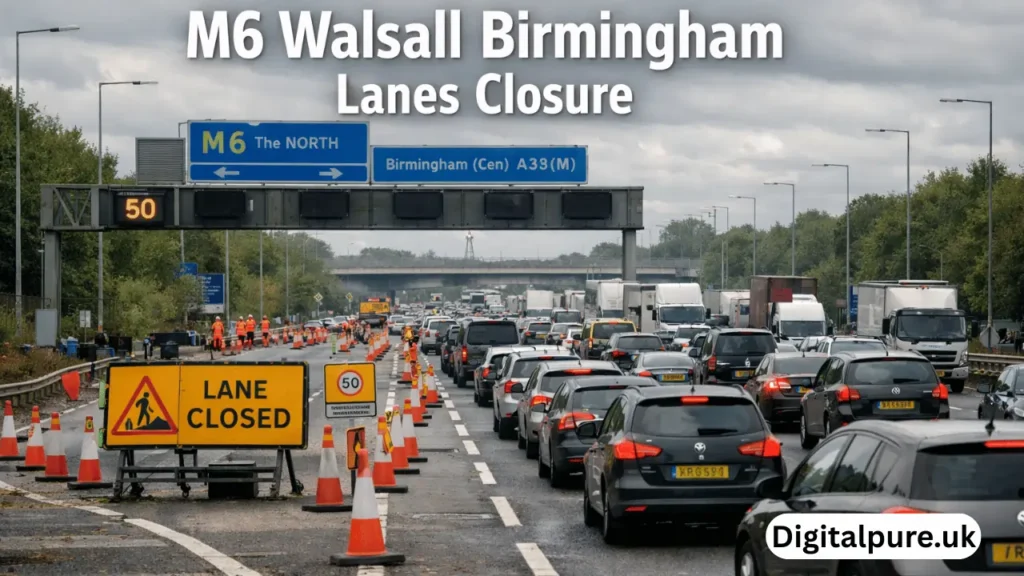
Recent resurfacing projects between Junction 6 and Junction 4 have brought repeated overnight closures, often stretching from late evening into early morning. Drivers hoping for relief during off-peak hours have found themselves caught in the same pattern.
The m6 walsall birmingham lanes closure linked to these works isn’t occasional—it’s scheduled, recurring, and expected to continue in phases. Bridge maintenance near Junction 5 and Junction 6 has added another layer, with full closures forcing diversions that spill onto already busy local roads.
Then there’s the influence of large-scale infrastructure projects. Slip road closures tied to wider development work have added pressure in ways that aren’t always obvious until you’re stuck in it.
At this point, roadworks aren’t the exception. They’re part of the baseline.
Accidents hit harder here than anywhere else
A crash on a quiet road is one thing. A crash in this corridor is something else entirely.
When an incident triggers a m6 walsall birmingham lanes closure, the impact multiplies fast. Multi-vehicle collisions have already shut down three lanes at a time, leaving a single lane to handle what should be a four-lane flow.
The result is predictable: miles of stationary traffic, delayed emergency response movement, and ripple effects that extend far beyond the immediate area.
Even smaller incidents—like a single broken-down vehicle—can trigger lane restrictions that behave like full closures during peak hours.
This stretch doesn’t absorb disruption well. It amplifies it.
The hidden cost of constant closures
Most discussions stop at “delays,” but the real impact runs deeper.
The m6 walsall birmingham lanes closure problem is quietly reshaping how people plan their day. Commuters leave earlier, deliveries build in buffer time, and local roads take on overflow traffic they weren’t designed to handle.
That overflow matters. When drivers divert, they push congestion into surrounding areas, creating new bottlenecks that weren’t there before.
There’s also a mental cost. Drivers expect delays now. That expectation changes behaviour—sometimes leading to risky decisions like late lane changes or aggressive merging just to avoid getting stuck.
It’s not just a motorway issue anymore. It’s a regional traffic pattern problem.
Timing matters more than ever
There used to be a clear logic to avoiding traffic—skip rush hour and you’re fine. That logic doesn’t fully apply anymore.
The m6 walsall birmingham lanes closure schedule often targets overnight hours, which sounds helpful on paper. In reality, it creates a different kind of disruption.
Late-night drivers, logistics operators, and long-distance travellers now face closures that didn’t exist before. Diversions at night are harder to navigate, less visible, and often poorly understood until you’re already committed to the route.
Daytime travel isn’t safer either. Unexpected incidents can turn a normal journey into a long delay within minutes.
Timing still matters—but it’s no longer reliable.
Why this keeps happening despite improvements
There have been attempts to fix things. Smart motorway systems, variable speed limits, and lane management tools were introduced to smooth traffic flow.
They help—sometimes.
But they don’t eliminate the core issue behind the m6 walsall birmingham lanes closure cycle. The road is operating at or beyond its intended capacity. Technology can manage flow, but it can’t create space where there isn’t any.
Upgrades and enhancements are ongoing, but they often require… more closures.
That’s the trade-off drivers are living with: short-term disruption in exchange for long-term improvement that never quite feels complete.
The worst junctions to watch
Not all sections are equal. Certain junctions consistently trigger or worsen closures.
Junction 6, linking directly into Birmingham, is a known pressure point. Traffic builds quickly here, and any restriction nearby causes immediate slowdowns.
Junction 10 near Walsall isn’t much better. Entry and exit slip roads see frequent closures, and even partial restrictions create noticeable congestion.
When the m6 walsall birmingham lanes closure affects these junctions, the delays don’t stay local—they spread in both directions.
Drivers who know the area already anticipate problems here. Those who don’t usually learn the hard way.
Alternative routes aren’t a perfect escape
The instinct to avoid the motorway is understandable. But it’s not always effective.
When a m6 walsall birmingham lanes closure pushes traffic off the main route, local roads absorb that pressure almost instantly. Routes that seem like smart shortcuts on a map quickly become clogged with diverted traffic.
This creates a loop: motorway congestion pushes drivers off, local congestion builds, and drivers return to the motorway hoping it’s improved.
Sometimes the best option is staying put and waiting it out—frustrating, but often faster than chasing alternatives that everyone else is already using.
What drivers are doing differently now
Regular users of this route have adapted.
Some track closure schedules closely and avoid travel during known work windows. Others build extra time into every journey, treating delays as inevitable rather than occasional.
There’s also a noticeable shift toward checking live traffic updates before and during travel. The m6 walsall birmingham lanes closure situation has made real-time information essential rather than optional.
And then there are those who simply avoid the route entirely when possible, even if it means longer distances.
That’s a significant change. When drivers start abandoning a major motorway, it says something about how reliable it feels.
Where this is heading
There’s no quick fix coming.
Planned improvements will continue, and some upgrades may ease specific pressure points. But as long as traffic demand stays high, the m6 walsall birmingham lanes closure pattern isn’t disappearing anytime soon.
In fact, short-term disruption may increase before it gets better. More upgrades usually mean more closures before any benefit is felt.
Drivers expecting a sudden return to smooth, predictable travel are likely to be disappointed.
The real takeaway
The m6 walsall birmingham lanes closure situation isn’t just a traffic issue—it’s a shift in how this route functions. It demands attention, planning, and a willingness to adapt.
Treat it like a normal motorway, and it will frustrate you.
Treat it like a system under constant pressure, and you’ll start making smarter decisions—when to travel, when to wait, and when to avoid it altogether.
That mindset makes all the difference.
FAQs
1. What time are closures most likely on this stretch?
Late evening to early morning closures are common due to roadworks, but daytime disruptions from accidents can happen without warning.
2. Is it better to take alternative routes during closures?
Not always. Local roads often become just as congested when traffic diverts, so switching routes doesn’t guarantee a faster journey.
3. How long do delays usually last after a lane closure?
It depends on the cause. Accidents can create delays lasting over an hour, while planned closures may have consistent but predictable slowdowns.
4. Are closures more frequent during certain months?
Yes. Maintenance and infrastructure projects often ramp up during specific periods, leading to clusters of closures rather than evenly spread disruptions.
5. Can real-time traffic apps fully help avoid delays here?
They help, but they don’t solve everything. By the time a closure appears on an app, traffic has often already built up.
You May Also Read: Vscompany: Sustainable Water Management and Industrial Service Solutions