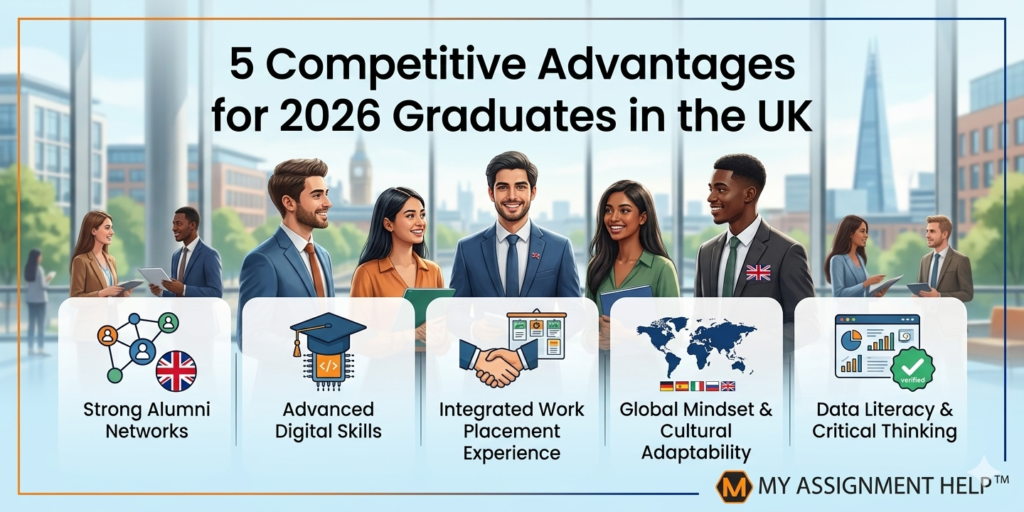

The Higher Education Statistics Agency (HESA) recently highlighted that while graduate employment rates remains robust, the nature of the roles being filled is undergoing a seismic shift. As we approach the 2026 graduation cycle, the UK labor market is no longer merely looking for a degree; it is scouting for “future-proof” adaptability. For students at prestigious Russell Group institutions and modern universities alike, the transition from lecture hall to the City or the Silicon Glen requires a strategic understanding of where the human edge meets technological integration.
The 2026 landscape is defined by the “Green Industrial Revolution” and the maturation of Generative AI. To stand out, graduates must pivot from being information absorbers to strategic executors. In an era where technical knowledge has a shorter half-life than ever before, the competitive advantages of tomorrow are rooted in hybridity—the ability to blend specialized academic rigor with cross-functional digital fluency.
Navigating these shifting requirements can be daunting, especially when final-year dissertations and exams peak simultaneously. Many students seek out myassignmenthelp to manage their academic workload, ensuring they have the headspace to focus on these critical career-ready skills. By utilizing custom assignment help, UK students can maintain their high-grade point averages while dedicating time to internships and certification programs that offer a tangible edge in a crowded marketplace.
1. The “Green-Tech” Fluency: Sustainability Meets Data
By 2026, the UK’s commitment to “Net Zero” will have moved from policy to operational reality across all sectors—from finance to construction. Graduates who possess “Green-Tech” fluency—the ability to interpret environmental data and apply it to business logic—will be at a significant advantage.
According to a report by Deloitte UK, the “Green Collar” workforce is expected to grow exponentially. It isn’t just for environmental scientists anymore; an accountant who understands carbon auditing or a marketer who can navigate the complexities of the UK’s Green Claims Code is infinitely more employable.
Strategic Action: Seek certifications in Carbon Footprint Management or Sustainable Supply Chain Management alongside your primary degree.
2. Cognitive Versatility and the “Value Speech”
In a world dominated by automated reports, the ability to articulate complex ideas with human nuance is the ultimate differentiator. Recruiters in 2026 are placing a premium on “Cognitive Versatility”—the capacity to switch between deep analytical thinking and high-level creative communication.
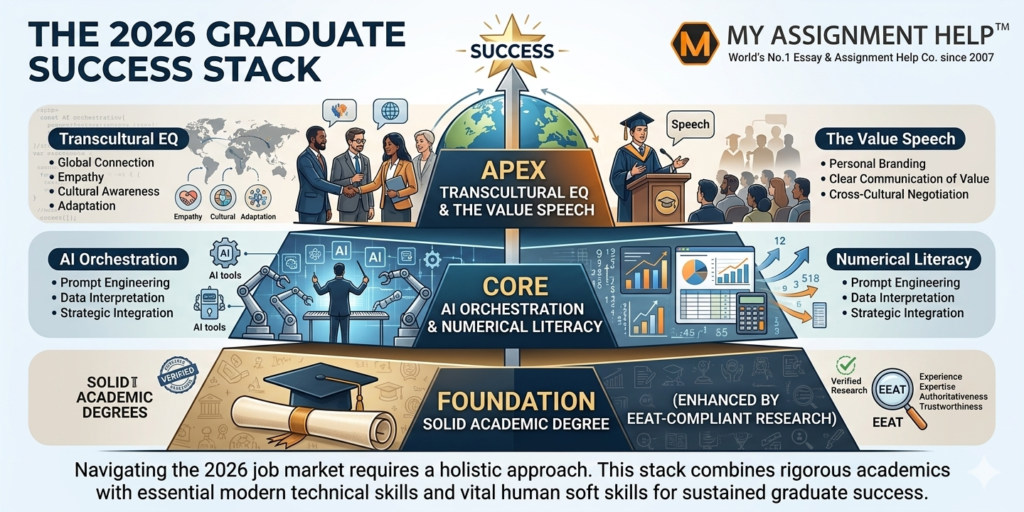
This involves mastering the art of the Value Speech, where a graduate can succinctly demonstrate their worth through ethical alignment and problem-solving. When preparing for high-stakes interviews or networking events, focusing on relevant value speech topics allows you to demonstrate your unique perspective on industry trends. Being able to present a narrative that resonates with a board of directors or a local council is a skill that AI cannot replicate.
3. AI Orchestration (Not Just Usage)
By 2026, “knowing how to use ChatGPT” will be as basic a requirement as “knowing how to use email” was in 2010. The competitive advantage lies in AI Orchestration. This means understanding the architecture of LLMs (Large Language Models), knowing how to mitigate AI bias, and managing the workflow between human oversight and machine output.
The UK government’s AI Safety Institute has emphasized the need for “AI-literate” professionals who can act as the “human-in-the-loop.” Graduates who can demonstrate they have managed projects where AI was used as a tool for efficiency—while maintaining rigorous quality control—will be the first to be hired in the tech and legal sectors.
4. Transcultural Emotional Intelligence (TEI)
With the UK strengthening trade ties through the CPTPP and other international frameworks, the 2026 graduate must be “globally local.” Transcultural Emotional Intelligence (TEI) is the ability to work effectively across diverse cultural norms, time zones, and communication styles.
As remote and hybrid work becomes the standard for UK firms like HSBC or Unilever, the ability to lead a virtual team consisting of members from Lagos, Mumbai, and London is crucial. This goes beyond language skills; it is about “cultural agility”—the ability to adapt your leadership style to suit the cultural context of your collaborators.
5. Numerical Literacy and Data Storytelling
Data is the new oil, but as the saying goes, it is useless unless refined. The 2026 graduate must be a “Data Storyteller.” This means taking raw data from UK market trends and turning it into a compelling visual or verbal narrative that can drive business decisions.
Whether you are a history major or a physics student, the ability to use tools like Tableau or PowerBI to explain why a trend is happening is vital. Employers are looking for people who can bridge the gap between “the numbers” and “the strategy.”
Key Takeaways
- Interdisciplinary is Mandatory: Don’t stay in your “subject silo.” Blend your degree with digital or environmental certifications.
- Communication is the Moat: As technical skills automate, your ability to influence and lead via human communication becomes your most defensible asset.
- Manage Your Time Strategically: Use support services to balance the “now” (grades) with the “future” (skill acquisition).
- Data is Your Language: Regardless of your field, become comfortable with data visualization and interpretation.
Frequently Asked Questions (FAQ)
Q1: Is a first-class degree still important in 2026?
While a first-class degree remains a strong signal of discipline, UK employers are increasingly moving toward “skills-based hiring.” A 2:1 paired with significant AI or Green-tech certifications is often viewed more favorably than a First with no practical digital skills.
Q2: How can I improve my “AI Orchestration” skills?
Look for courses that focus on “Prompt Engineering,” “AI Ethics,” and “Data Privacy Laws (UK GDPR).” Implementing these in your university projects is a great way to build a portfolio.
Q3: What are “Green Skills”?
These are skills required to support a sustainable, low-carbon economy. They range from technical engineering skills to “soft” skills like understanding environmental legislation and sustainable business strategy.
Q4: Does “myassignmenthelp” provide UK-specific academic support?
Yes, the service specializes in the UK curriculum, ensuring that formatting, British English standards, and specific university guidelines are strictly followed.
References
- HESA (2025). Graduate Outcomes Survey: Trends and Projections for 2026.
- Deloitte UK (2024). The Rise of the Green-Collar Workforce.
- UK Department for Science, Innovation and Technology (2025). AI Skills Gap Report.
- World Economic Forum (2023). The Future of Jobs Report (2023-2027).
Author Bio: James Sterling
James Sterling is a Senior Academic Consultant and Content Strategist at myassignmenthelp. With over a decade of experience in the UK higher education sector, James specializes in helping students bridge the gap between academic theory and professional practice. He is a regular contributor to EdTech journals and is passionate about helping the 2026 cohort navigate the complexities of the modern job market through strategic SEO-driven content and EEAT-compliant research.