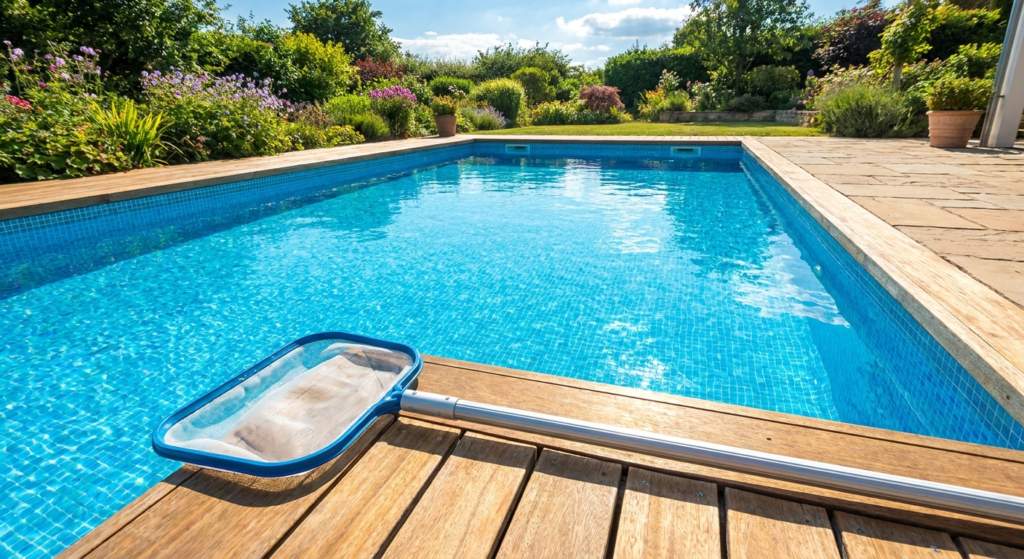

A swimming pool is a wonderful addition to any home, but it requires consistent care to remain clear, safe, and inviting.
Skipping routine maintenance can lead to cloudy water, algae blooms, and equipment damage. Fortunately, the fundamentals of pool care are straightforward.
This guide breaks down the essential tasks into manageable steps, helping you keep your pool in excellent condition throughout the year.
The Three Pillars of Pool Maintenance
Pool maintenance revolves around three interconnected areas: circulation, cleaning, and chemistry. When all three are properly managed, the water stays clean, the equipment lasts longer, and the swimming experience is far more enjoyable. Neglecting any one of these pillars creates problems that affect the others.
Circulation: Keep Water Moving
Stagnant water is a breeding ground for algae and bacteria.
Your pump and filter system must run long enough each day to circulate the entire volume of water through the filter.
This process, known as turnover, typically requires the pump to run 8 to 12 hours daily.
During hot weather or heavy pool use, you may need to extend that time.
The return jets should be angled downward at about 45 degrees to create a circular flow that pushes debris toward the skimmer and main drain.
Dead spots — such as corners, steps, and behind ladders — need extra attention because they receive poor circulation.
Skimmer baskets should be emptied once or twice a week to maintain strong water flow, and the pump basket should be checked monthly.
Filter maintenance is equally important. Monitor the pressure gauge on the filter.
When the pressure rises 8 to 10 PSI above the clean baseline, the filter needs backwashing (for sand or DE filters) or cleaning (for cartridge filters).
Cartridge filters should be hosed off monthly and deep‑cleaned at least twice a year.
Sand filter media should be replaced every 5 to 7 years, while DE grids typically last 1 to 2 years.
Cleaning: Physical Removal of Debris
Even with excellent circulation, debris and contaminants accumulate on pool surfaces. A daily skim with a net removes leaves, insects, and other floating debris before they sink and stain the pool finish. This simple five‑minute task prevents many bigger problems.
Wall and floor brushing is a weekly necessity.
Algae spores settle on surfaces and begin to grow, especially in porous concrete or plaster pools.
Use a nylon brush for vinyl liners and fiberglass, and a stainless‑steel brush for concrete or gunite.
Pay special attention to the waterline, steps, and corners where biofilm forms most readily.
Vacuuming the pool floor every week removes settled dirt that the skimmer cannot reach.
Manual vacuums connect to the filtration system and require the user to guide the head across the pool.
Automatic cleaners — either suction‑side, pressure‑side, or robotic — can reduce manual effort, but they do not replace the need for brushing and skimming.
Chemistry: Balancing Water Quality
Balanced water chemistry is critical for swimmer comfort, sanitizer effectiveness, and equipment protection.
Test the water two to three times per week during swimming season using a reliable test kit or test strips.
The key parameters to monitor are free chlorine (1–3 ppm), pH (7.2–7.6), total alkalinity (80–120 ppm), calcium hardness (200–400 ppm), and cyanuric acid (30–50 ppm).
pH is the most important factor because it directly affects how well chlorine works.
At pH 7.2, chlorine is about 65% effective, but at pH 8.0, effectiveness drops to only 21%.
Use pH increaser (soda ash) to raise pH or pH decreaser (dry acid) to lower it.
Total alkalinity acts as a buffer to prevent pH from swinging wildly.
If alkalinity is too low, use alkalinity increaser; if too high, add muriatic acid.
Cyanuric acid stabilizes chlorine against sunlight degradation. Outdoor pools typically need 30–50 ppm of stabilizer.
However, cyanuric acid does not dissipate; it can only be lowered by diluting the pool water. For this reason, avoid over‑stabilizing.
Shock the pool weekly to oxidize organic contaminants and eliminate chloramines, which cause the strong chlorine smell and eye irritation.
Weekly and Monthly Tasks
A consistent weekly schedule keeps the pool in good shape.
Each week, test the water, adjust chemicals as needed, skim daily, brush walls, vacuum the floor, empty skimmer baskets, and shock the pool if necessary.
Check the filter pressure and clean the filter when the pressure rises. Total weekly time is approximately 60 to 90 minutes.
Monthly tasks include testing calcium hardness and cyanuric acid, inspecting the pump and heater for leaks or unusual noises, lubricating O‑rings with silicone lubricant, cleaning the pool deck, and checking the water level.
Deep cleaning the filter with a chemical soak is also recommended monthly during peak season.
Seasonal Care and Troubleshooting
Opening the pool in spring requires removing the cover, reconnecting equipment, filling the water, and performing a heavy shock after balancing the chemistry. Closing the pool for winter involves lowering the water level, adding winterizing chemicals, blowing out plumbing lines, and securing a cover.
Common problems have simple solutions.
Green water typically indicates an algae bloom caused by low chlorine or high pH. Shock the pool to 30 ppm and brush thoroughly.
Cloudy water often results from poor filtration, high pH, or high calcium hardness.
Check the filter pressure, balance the chemicals, and use a clarifier if needed.
A strong chlorine smell means chloramines are high — shock the pool to break them down.
Conclusion
Mastering pool maintenance is not complicated once you understand the three pillars of circulation, cleaning, and chemistry.
A few minutes each day and a weekly routine will prevent most problems and keep your water inviting all season.
For more detailed instructions and a structured approach to every aspect of pool ownership, refer to the pool care complete guide which covers everything from seasonal timing to equipment troubleshooting.
With consistent care, your pool will remain a safe and refreshing retreat for family and friends.